
Heuristic evaluation of the ACLIMATAR website

Glashaus Innovation was commissioned to evaluate the usability of the ACLIMATAR platform and identify opportunities to strengthen user engagement and task completion. The Glashaus mission involved a detailed interface and analytics review resulting in a design advisory report.

When good data isn’t enough: Why UX matters and how it impacts UI decisions.

The ACLIMATAR platform offers rich, localized climate intelligence for climate adaptation planning, but users are struggling to unlock its full potential and value. Our UX evaluation exposed where and why, offering concrete guidance to reinforce user engagement and value.

Problem Statement

How might we improve user engagement with the ACLIMATAR platform, enabling agricultural professionals to intuitively access, interpret, and apply climate adaptation recommendations on their own?

Jump to results

Solution

From Complexity to Clarity: Uncovering interface design opportunities to make climate data more accessible and useful

Glashaus delivered an evaluation report that brings the full analysis together. It shows where the interface already works well, ranks usability problems by severity, and pairs each one with targeted UX/UI recommendations and concrete next steps, including effort estimates. It also sets out principles for a consistent, accessible and scalable design system. The result gives the ACLIMATAR team a strategic UX roadmap they can act on right away, moving them closer to their mission: climate adaptation data that people can actually use, act on and access, whoever they are.

Approach & Methodology

To assess the usability and performance of the platform, we triangulated results.

We created a UX/UI documentation review to gain understanding about Jobs-to-be-Done. This comprised

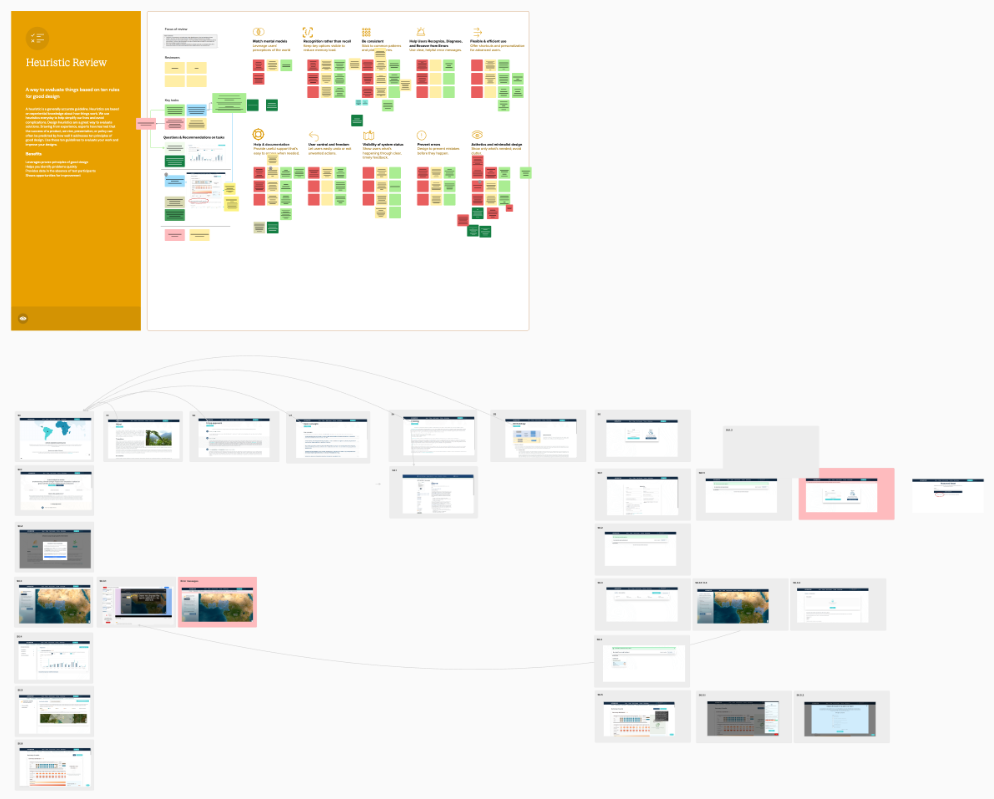
  • Heuristic Analysis: Using Jakob Nielsen’s ten usability heuristics, we evaluated key platform screens and workflows to identify usability issues, best practices, and missed opportunities (see screenshot: Mural board). Findings were ranked from cosmetic to critical
  • Google Analytics Review: A deep dive into user behavior data revealed usage patterns, drop-off points, and underperforming features, validating findings from the heuristic review.
  • Recommendations: Our final recommendations aimed at aligning interface behavior with user goals (Jobs-to-be-Done) and decision-making moments.

This multi-angle approach allowed us to connect the dots between user behavior, interface structure, and platform goals - producing a roadmap grounded in evidence and aligned with user needs.
Key Results

1. Prioritize what matters to users
2. Always show where users are
3. Triangulate to set priorities

We are offering not just critique, but a vision for stronger, more intuitive user experiences.

Our evaluation focused on clear, actionable insights that now guide the ACLIMATAR team toward improved platform usability. Each identified challenge came with a strategic design response.

  • A targeted content audit and structural redesign helps prioritize what matters most to users, surfacing key insights and actions while reducing clutter. This lays the foundation for faster navigation and better comprehension.
  • Restructuring user flows, automating repetitive steps, reducing manual inputs, and enabling users to adjust parameters mid-flow to support greater flexibility without forcing them to start over.
  • Reducing cognitive friction in workflows by visualizing user progress and current selections throughout the experience. This helps users stay oriented, track decisions, and understand “what happens next”, which is particularly valuable in multi-step processes.
  • Design faster ways to surface climate recommendations earlier in the flow and highlight them visually. Help clarify the platform’s promise and accelerate moments of user value.
  • Ensure users aren’t left guessing, even when the platform’s content is complex or data is missing. Provide contextual help or visible support options, especially to support first time users.

Impact

Our recommendation provide a clear roadmap for improving current usability, but also a foundation for future, region-inclusive platform versions, showing concrete next steps to making the ACLIMATAR platform more intuitive, actionable, and scalable)

  • Task completion and user satisfaction — by reducing friction, clarifying user flows, and providing visible support at the right moments.
  • Engagement and retention — by helping users experience the value of the tool faster and more seamlessly.
  • Accessibility and inclusion — by ensuring the design supports diverse audiences with varying degrees of digital literacy, technical familiarity, or local context.
  • Design system foundations - defining cohesive interaction patterns, content hierarchy, and visual consistency across screens.

Ultimately, tools that are easy to use are more likely to be used again, recommended, and integrated into real decision-making, creating impact on the ground. Our recommendations focus on enabling that cycle of trust and return use.

Heuristic Analyses can stand alone as a high-impact, low-commitment starting point to optimize what you already have. They are often the beginning of a longer collaboration.
Aline
/
Design & Communication Lead | Glashaus Innovation

Is this service for you?

Our Heuristic + Analytics Evaluation is a fast, insight-rich entry project designed to help you understand how your digital product is really performing from a usability perspective. It’s ideal for:

  • Web and mobile platforms
  • Digital tools and services
  • Even analog service experiences, with adaptation

We customize every project to your needs. Whether you’re planning a redesign or just want an expert outside perspective - we’ll help you scope the right approach.

‍

Book a call

Check more projects

VIEW

From in-person training to AI-powered onboarding at scale

When in-person training can't scale, something has to give. For Artemis, that meant rethinking onboarding from the ground up — because onboarding isn't training. It's the moment someone decides to stay. The answer: one adaptive AI guide, built for the field, ready to scale.
VIEW

Headlines from the future

A participatory visual gallery on land and water use from Brandenburg to Northern Brazil