
.svg)
The Artemis project develops AI-powered phenotyping tools that help plant breeders collect and analyze phenotypic data faster and more accurately. As the project is growing to new crops and regions, so does the cost and complexity of onboarding: new users require in-person training, remote support via WhatsApp, and ongoing coordination that the team cannot sustain sustainably. Artemis needed a smarter way in.

When in-person training can't scale, something has to give. For Artemis, that meant rethinking onboarding from the ground up — because onboarding isn't training. It's the moment someone decides to stay. The answer: one adaptive AI guide, built for the field, ready to scale.
In plant breeding, phenotyping refers to measuring observable plant traits—such as yield, height, or disease resistance—to identify the best candidates for improvement.Artemis has developed an AI-powered system for this: a mobile app for image capture in breeding trials, a vehicle to support image collection, and a dashboard where breeders can review images and access AI-based trait extraction results.
Because this represents a new way of working, onboarding isn’t optional, but a crucial gateway to adoption. The team created materials across multiple formats and platforms to train users on tool access, standard operating procedures for image capture, and the broader use of AI in phenotyping. But the approach had grown fragmented and management was questioning the efficiency of in-person training, struggling to envision how the approach can scale with expansion to new crops, regions and features on the horizon. The question was no longer how to improve what existed, but whether it could scale at all.

How might we deliver an adaptive onboarding experience for Artemis tools, at scale, within cost?
A WhatsApp bot that meets every user where they are and adapts to how they learn - at their pace, in their language, on a platform they already use.
Like many research projects, the situation and scaling plans of the program are ever-evolving. So a strategy would need to take this fluidity into account: New users are targeted all the time, and with this new languages, knowledge levels and learning preferences.
A strategy built to flex: how three lenses turned a scaling problem into a design brief:
1. User reality: What users is the project trying to serve and what is their specific need and skills when they come to the tools?
2. Project requirements: What is the project trying to achieve? E.g. how much resources can it afford to invest in Onboarding materials and Journey management?
3. Onboarding best practices: How might the onboarding tactic minimize friction, prove to be consistently at the side of new users, and communicate value?
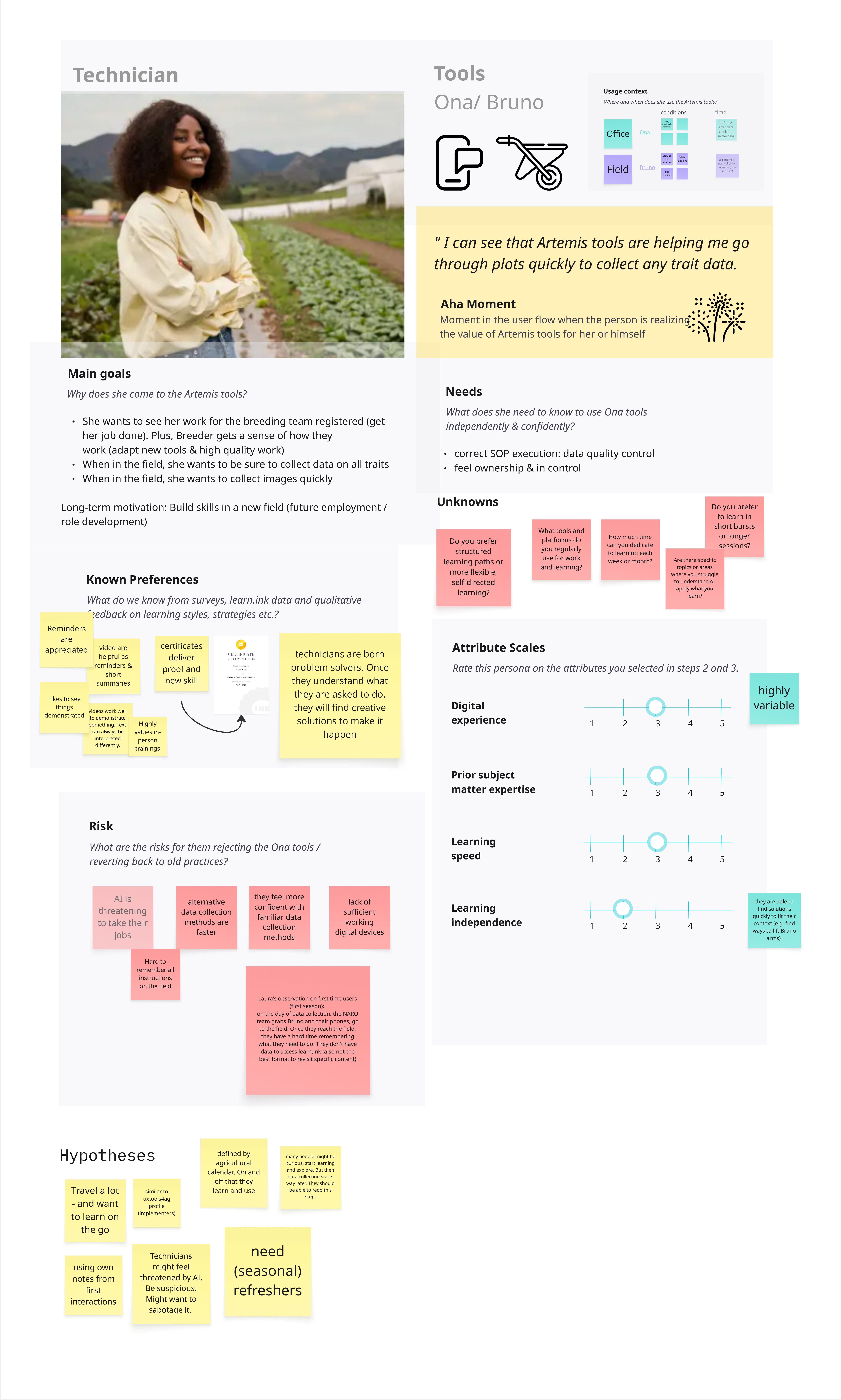
Learner Profile for Artemis Technician
The Artemis team already had strong user research: detailed personas, field observations, and first-hand experience of what breaks down during onboarding. The challenge wasn't insight; it was synthesis.
In a series of workshops with the team, we extended the existing user personas into Learner Profiles: a new lens focused specifically on how different users come to the tools, their goals and motivations, moments of value creation, and what threatens to lose them. We then mapped these into Onboarding Journeys.
We shifted perspectives. From asking: "what do users need to understand?" to "what creates value and joy for them from their very first interaction?" That shift from teaching to welcoming, changed which moments on the journey deserved the most design attention, and what the right channel to deliver them through should be.
getting away from the perspective of teaching: what do they need to understand? to the notion of welcoming: what creates joy and value for them? We reframed the question: not 'what do users need to understand?' but 'what creates value and confidence for them from the very first interaction?'
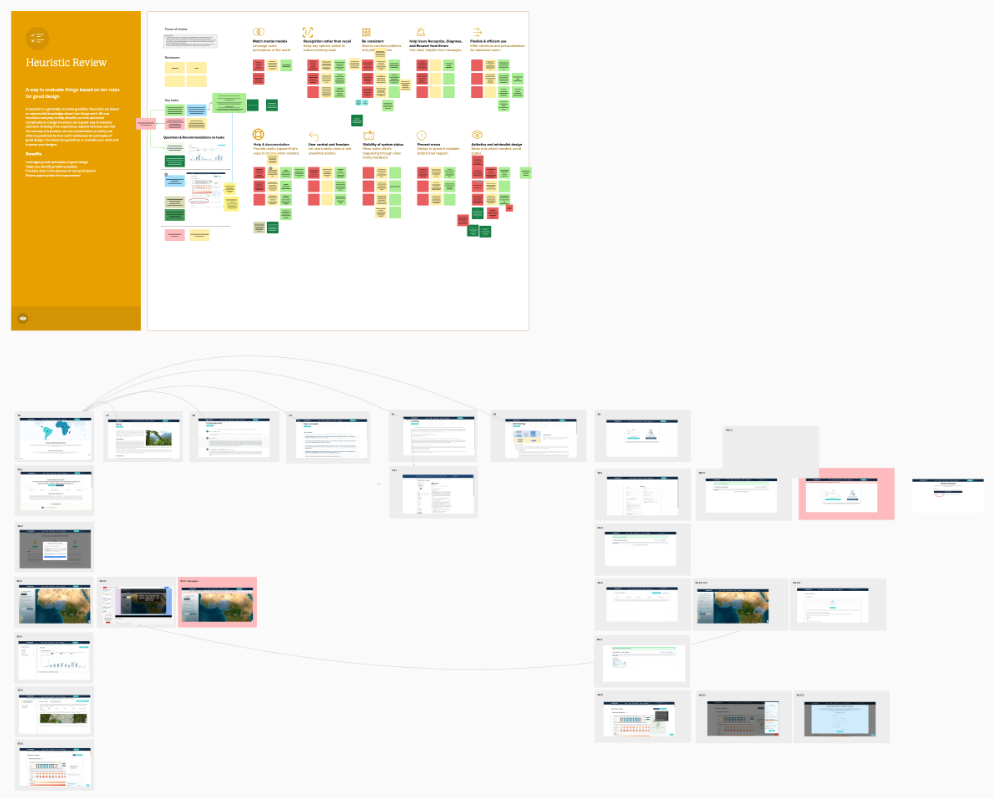
2 learner profiles, 2 onboarding journeys, 1 bot strategy with 5 behavioral modes, a 3-phase roadmap, 1 knowledge base architecture, maintainable by a small team
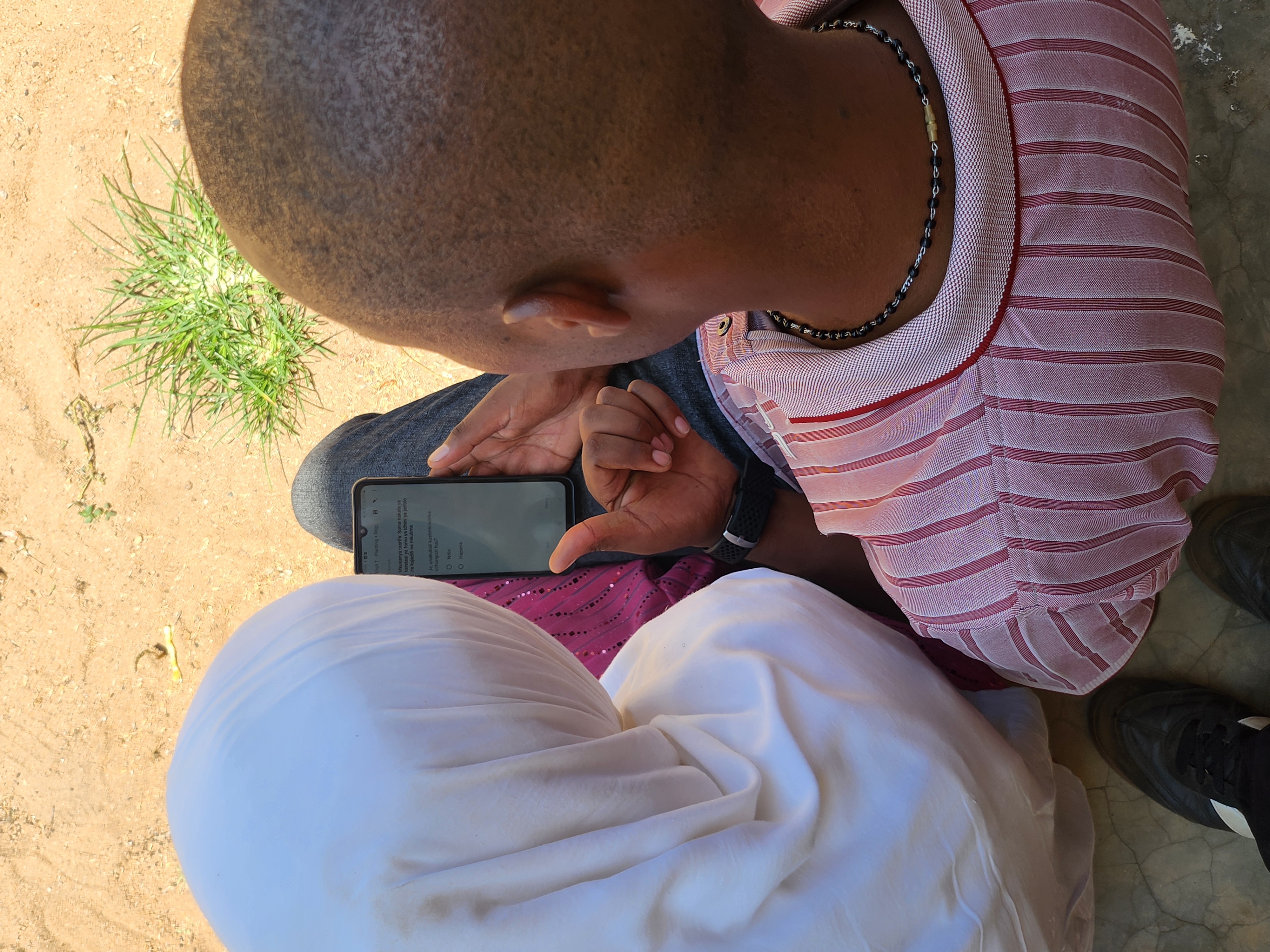
Individualized AI-powered Onboarding is ready to scale to troubleshooting & support without the need for in-person interventions.
From the analysis of user insights, we learned that Onboarding for Artemis tools should build confidence, ensuring technicians feel capable and in control, while breeders need to establish trust in the new approach of collecting data. It should highlight efficiency by making data collection with the image collection App feel faster and lighter, enabling users to move quickly without sacrificing completeness. At the same time, any Onboarding channel must work reliably in real-world conditions and across repeated cycles, with guidance embedded in tasks and support available through clear re-entry points and refreshers.
Build confidence
Technicians need to feel capable and in control. Breeders need to trust a fundamentally new way of collecting and interpreting data.
Highlight efficiency
Data collection should feel faster and lighter — enabling users to move quickly through tasks without sacrificing completeness or data quality.
Stay present
Onboarding can't end after the first session. Guidance needs to be embedded in tasks, with clear re-entry points and refreshers that work reliably across repeated field cycles.
From these principles we derived clear requirements and constraints to the solution: something adaptive, available on demand, and deployable without ongoing human coordination. The diversity of the user group - spanning ages, education levels, languages, and varying familiarity with AI -made a one-size-fits-all format impossible. And the cost constraint ruled out building and maintaining a dedicated training platform.
The result: an LLM-powered WhatsApp bot connected to the Artemis knowledge base, with five defined behavioral modes that shift depending on where the user is in the journey and what they need in that moment. A technician navigating a complex SOP in the field gets a different experience than a breeder building trust in a new data ecosystem. The bot fulfills the requirements to communicate with users only the relevant information, when they need it and in a format that is accessible for the majority.

An AI-enabled WhatsApp bot meets users on a platform they already use, lowering barriers to adoption across diverse and distributed teams. The bot adapts to each user’s prior knowledge and delivers the right information at the right moment, guiding them through tools and workflows in a conversational, step-by-step way.
Connected to the Artemis knowledge database, it provides instant answers, generates onboarding and training paths dynamically, and communicates in multiple languages and formats. As the project expands to new crops and regions, the bot scales automatically: once SOPs, or new features are production ready, they feed the knowledge base, which is picked up automatically by the bot.
By merging onboarding with ongoing support, the bot enables users to learn and troubleshoot independently while significantly reducing the need for continuous human-led training and maintenance.

Learner Profile for Artemis Technician
Our strategy services help you turn insights into clear direction, ensuring your innovation is grounded in real user needs and built for long-term impact and scale. We support you in defining the right problems to solve, aligning stakeholders, and translating research into actionable roadmaps across the entire innovation process.
Our approach is especially valuable for:
• Designing and scaling digital products and platforms
• Shaping new services, tools, and systems
• Navigating complex or evolving problem spaces where user needs are not yet fully understood
We customize every project to your needs. Whether you’re planning a redesign or just want an expert outside perspective - we’ll help you scope the right approach.
Working with design artefacts like Personas and journeys is a tested and proven way to ensure user-centeredness from the start.
— Aline, Design & Communication Lead | Glashaus Innovation


.png)