
.svg)

The Leibniz Lab "Systemic Sustainability" and the Leibniz Centre for Tropical Marine Research commissioned a participatory stakeholder exchange on land and water use innovation, ahead of the Climate COP-30 in Brazil in November 2025. The brief: collect and visualize experiences from two regions - Brandenburg and North Brazil - through a format that could speak to both exhibition and policy audiences.
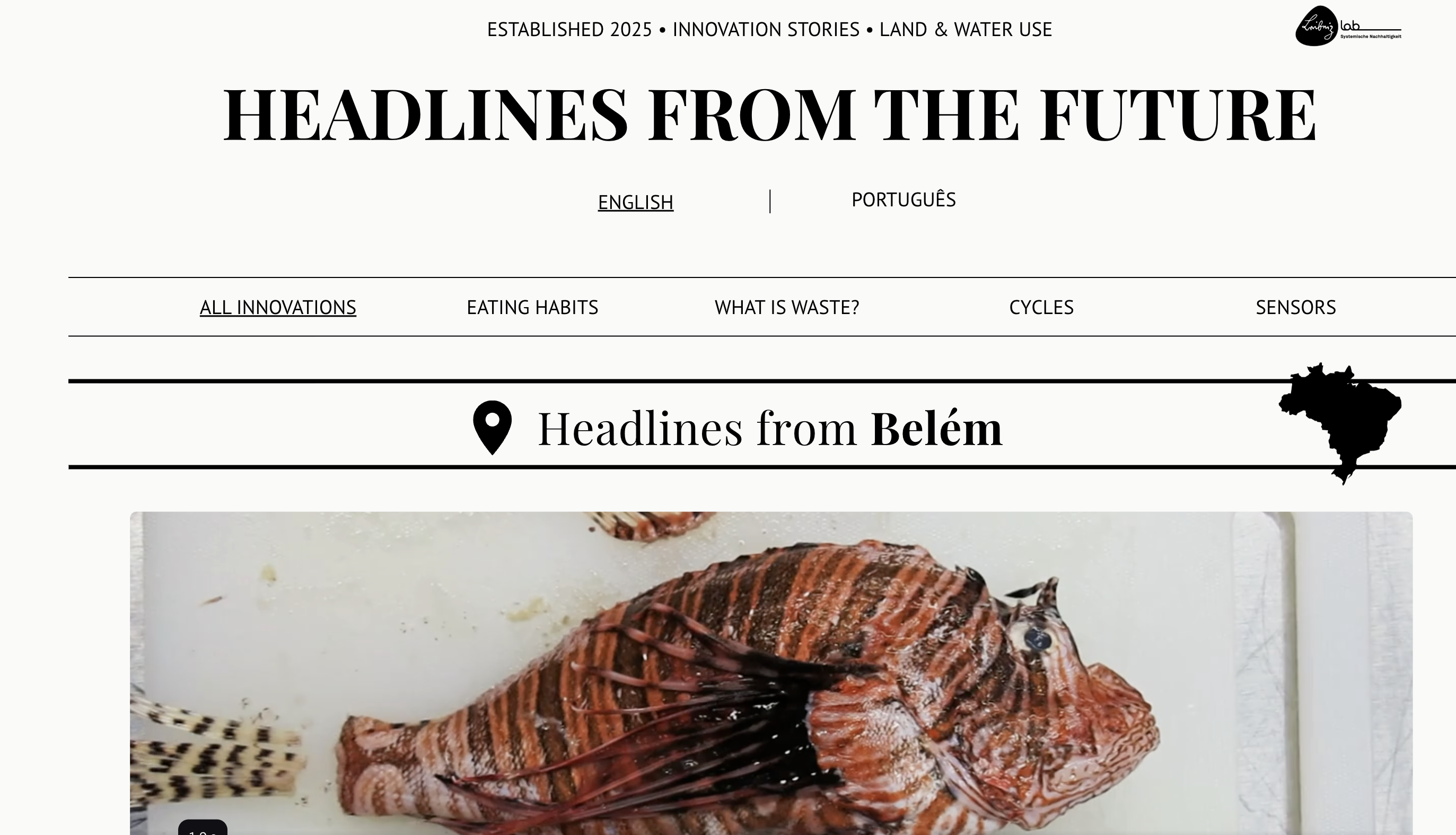
A participatory visual gallery on land and water use from Brandenburg to North Brazil
Agri-food systems in Brandenburg and North Brazil are under pressure from the same structural forces; climate change, biodiversity loss, resource scarcity. Still, the innovations emerging in response rarely travel between regions, and rarely reach the policy tables where they could matter. The stakeholder exchange was part of a broader effort to surface knowledge and experience around innovation and transformation in agri-food systems: what's driving change, what's blocking it, and what pathways are actually working on the ground.

How might we turn stakeholders from research subjects into storytellers of their own transformation?
Participants as authors: How participatory media production turned local knowledge into a cross-continental gallery
We designed and facilitated a participatory process that resulted in a bilingual digital gallery - Headlines from the Future - built entirely from media created by the participants themselves. Structured as a fictional newspaper from 2050, the gallery captures the story of innovations along the four steps of the hero journey, that all great tales follow:

We used challenges and visions for land and water use from both regions in a format that works equally well as a facilitated walk-through, a travelling exhibition, and a visual argument for policy audiences at COP30 in Belém.

The structure given by the hero’s journey and the journal itself created a great structure for participants to narrate their story not to their peers only, but to a wider audience, and with more than words - videos, photos and graphics were used to carry the main weight of storytelling.

The project was presented at the COP-30 in Belém and is currently being taken up as part of the Senckenberg Society for Natural History Research exhibition.
Our exploratory research services comprise all necessary steps to set your project up for user adoption and scale. We help you understand and integrate user needs in early stage prototyping and throughout the innovation development process. It’s ideal for:
We customize every project to your needs. Whether you’re planning a redesign or just want an expert outside perspective - we’ll help you scope the right approach. Working with design artefacts like Personas and journeys is a tested and proven way to ensure user-centeredness from the start. — Aline, Design & Communication Lead | Glashaus Innovation

.png)